Quick Answer
A portable EV charger is a plug-in unit that moves with the owner and needs no installation, while a home charging station is a hardwired, fixed unit installed by a licensed electrician. Portable chargers, such as the Ocular IQ Portable OCPP, suit renters or drivers who need flexibility. Home charging stations, such as the Ocular IQ Home Solar or Ocular IQ Wallbox V2, suit homeowners who want faster, dedicated charging in a fixed location.
- Portable chargers: plug into a socket, no electrician required for use, slower charging speed, ideal for renters or backup charging
- Home charging stations: hardwired to the switchboard, require professional installation, faster charging, ideal for a fixed home setup
- Speed difference: a home charging station charges considerably faster than a portable charger plugged into a standard socket
- Solar option: only a home charging station, specifically the Ocular IQ Home Solar, can charge directly from solar panels
Side-by-Side Comparison
| Feature |
Portable EV Charger |
Home Charging Station |
| Installation |
No installation, plugs into an existing socket |
Hardwired by a licensed electrician |
| Mobility |
Moves with the owner between properties |
Fixed in one location |
| Charging speed |
Slower, limited by socket type and amperage |
Faster, dedicated Level 2 circuit |
| Typical example |
Ocular IQ Portable OCPP |
Ocular IQ Home Solar or Ocular IQ Wallbox V2 |
| Solar compatible |
No |
Yes, with the Ocular IQ Home Solar |
| Best suited to |
Renters, fleet drivers, backup charging |
Homeowners with a fixed parking space |
What Is a Portable EV Charger?
A portable EV charger is a self-contained unit that plugs into an existing power outlet rather than being wired directly into the switchboard. It travels with the car or the owner, rather than staying fixed to one property.
The Ocular IQ Portable OCPP, available through evse.nz, is built with a 4G modem, so charging sessions can be monitored and logged without relying on home Wi-Fi. It is available in 8 Amp, 32 Amp single-phase, and 32 Amp three-phase versions.
Situations where a portable charger makes sense:
- Renting a property where a hardwired installation is not possible or practical.
- Needing to charge a company vehicle at different locations, such as an employee’s home.
- Wanting a backup charging option alongside a fixed home charger.
- Charging occasionally, where speed is less important than flexibility.
What Is a Home Charging Station?
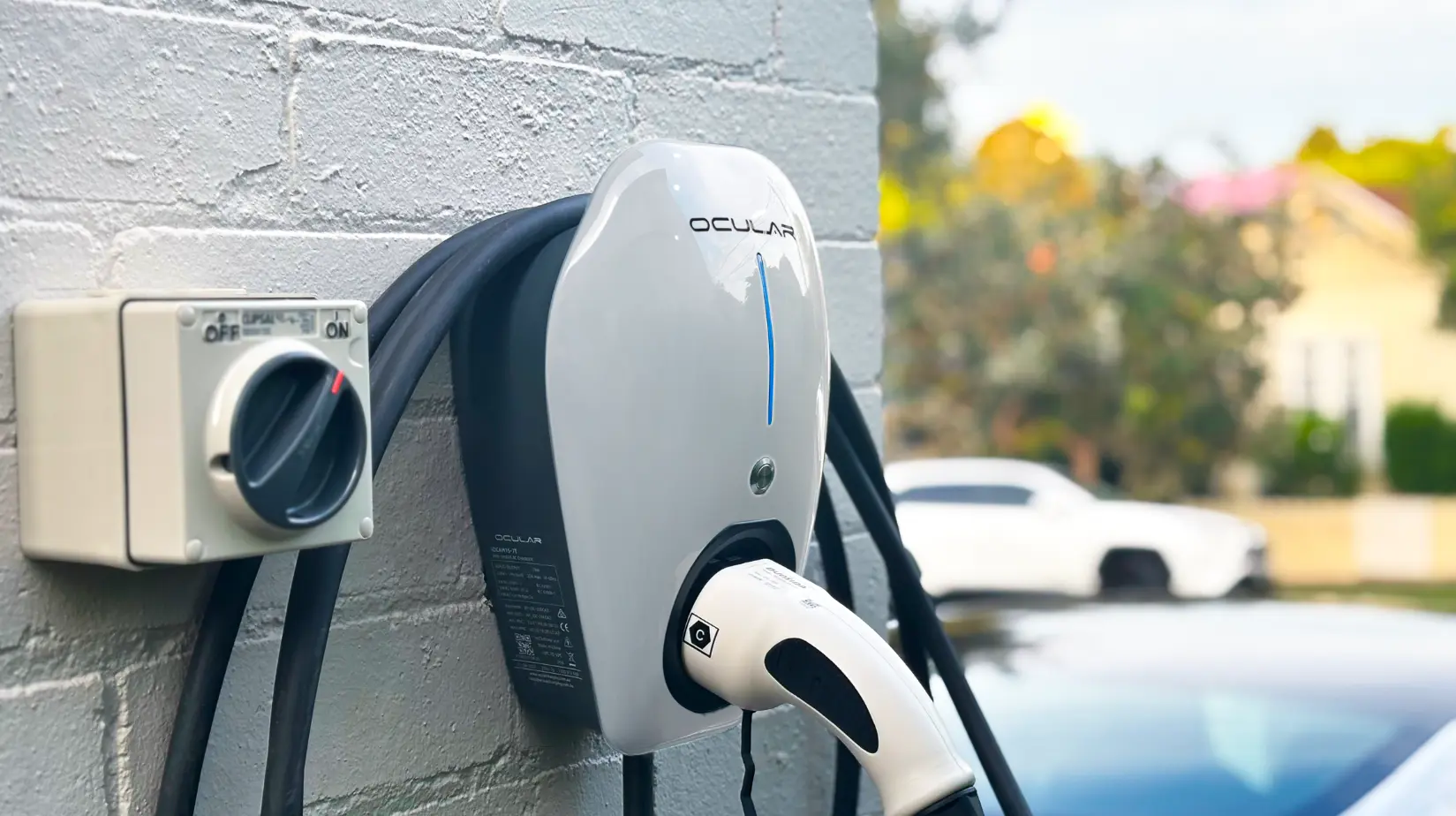
A home charging station, sometimes called a wallbox, is a Level 2 charger hardwired into a property’s electrical system by a licensed electrician. It stays fixed in one location, typically a garage or driveway wall, and delivers power at a higher, dedicated rate than a standard socket.
The Ocular IQ Home Solar and Ocular IQ Wallbox V2 are both home charging stations, available in 7kW and 22kW versions depending on the property’s power supply. The Home Solar adds the ability to charge directly from solar panels, using built-in CT clamps to match charging speed to available solar generation.
Situations where a home charging station makes sense:
- Owning the property, with a fixed parking space available.
- Driving daily and needing a full charge overnight.
- Wanting solar integration, smart scheduling, or app-based monitoring.
- Planning to keep an EV long term, where the upfront installation pays off in convenience.
Charging Speed Comparison
| Charger Type |
Typical Output |
Approx. Range Added Per Hour |
| Portable charger, 8A |
Around 1.8kW |
Roughly 8km to 10km |
| Portable charger, 32A single-phase |
Around 7kW |
Roughly 40km |
| Home Solar or Wallbox V2, 7kW |
7kW |
Roughly 40km to 50km |
| Home Solar or Wallbox V2, 22kW |
22kW (three-phase) |
Roughly 120km to 140km, if the vehicle supports it |
Range-added figures are approximate and will vary by vehicle and onboard charger capability.
Cost Considerations
- Portable chargers: generally lower upfront cost, and no electrician installation fee since the unit plugs into an existing socket
- Home charging stations: higher upfront cost, since the price includes both the charger and professional installation, but deliver a faster and more convenient long-term charging setup
Which One Should You Choose?
The right choice depends on where the car is charged, how often, and whether the property is owned or rented.
- Choose a portable charger, such as the Ocular IQ Portable OCPP, if renting, charging at multiple locations, or needing a flexible backup option.
- Choose a home charging station, such as the Ocular IQ Home Solar or Wallbox V2, if the property is owned, charging happens daily, or faster charging and solar integration are priorities.
Homeowners unsure which option fits their situation can compare both ranges through evse.nz before deciding.
Frequently Asked Questions
Can I use a portable charger instead of installing a home charging station?
Yes, a portable charger such as the Ocular IQ Portable OCPP can be used as a primary charging method. It charges more slowly than a hardwired home charging station, so it suits drivers with lower daily mileage or more flexible charging schedules.
Is a portable EV charger safe to use with a standard household socket?
Yes, when used as designed and matched to the correct amperage for the socket. A licensed electrician can confirm whether a household circuit is suitable for regular EV charging use.
Does a portable charger need to be installed by an electrician?
No installation is required to use a portable charger, since it plugs into an existing socket. A home charging station does require installation by a licensed electrician.
Can a portable charger use solar power?
No. Solar-matching charging requires a charger built with that capability, such as the Ocular IQ Home Solar. Portable chargers charge at a fixed rate regardless of solar production.
Which option is better for someone who owns their home?
A home charging station, such as the Ocular IQ Home Solar or Ocular IQ Wallbox V2, is generally the better long-term option for homeowners, since it charges faster and is designed to stay in place permanently.